Dataset · Arithmetic from a published definition; no measurements
HDD rotational latency by spindle speed
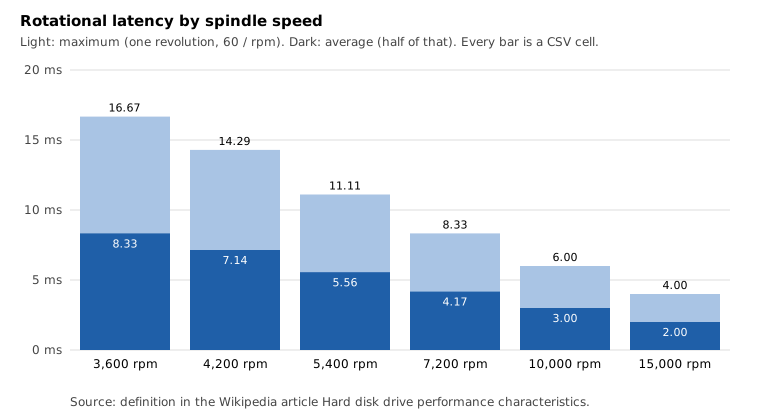
Maximum and average rotational latency of a hard disk drive for six spindle speeds from 3,600 to 15,000 rpm, computed as 60 / rpm and half of that, and checked against the values printed in the cited Wikipedia article. At 7,200 rpm one revolution takes 8.33 ms and the average wait is 4.17 ms, and at 15,000 rpm they are 4.00 ms and 2.00 ms. Arithmetic from a definition, no measurements and no seek times.
Download CSV6 rows · 6 columns · CSVMethod
Rotational latency is the wait for the platter to bring the requested sector under the head. One revolution takes 60 / rpm seconds, which is the maximum wait, and the average wait is half of that. Each row applies those two formulas to one spindle speed, with 1 ms = 1/1000 s. The published column is the average printed in the cited article and is compared with the computed value. The IOPS column is 1000 divided by the average latency in ms and assumes rotation is the only delay. Seek time and data transfer time are separate terms of access time and are not in this table.
maximum latency = 60 ÷ rpmseconds (one revolution)average latency = 0.5 × maximum latencyIOPS if rotation were the only delay = 1000 ÷ average latency (ms)
The build recomputes every cell and fails if the computed average differs from the value printed in the cited article.
Counted here
- At 7,200 rpm one revolution takes 8.33 ms and the average rotational latency is 4.17 ms. At 15,000 rpm the two are 4.00 ms and 2.00 ms.
- Going from 3,600 rpm (8.33 ms) to 15,000 rpm (2.00 ms) cuts the average rotational latency by a factor of 4.17, the same as the ratio of the spindle speeds.
- Access time adds seek time and transfer time to this wait. As an illustration with a seek time chosen here, not measured: a 8 ms average seek plus the 4.17 ms at 7,200 rpm is 12.17 ms before any data moves.
Chart
Limits
- Arithmetic from a definition, not measurements of any drive. No confidence interval applies.
- The average assumes the target sector is equally likely to be anywhere on the track. Real workloads, command queuing and drive firmware can change the wait.
- Access time also includes seek time and transfer time. The IOPS column is a ceiling if rotation were the only delay, not a prediction for any drive.
- Spindle speeds are the round values in the cited article. A drive can differ from its nominal speed.
Table
| Spindle speed (rpm) | Revolutions per second | Maximum latency (ms) | Average latency (ms) | Published average (ms) | IOPS if rotation only |
|---|---|---|---|---|---|
| 3,600 | 60.00 | 16.67 | 8.33 | 8.33 | 120.0 |
| 4,200 | 70.00 | 14.29 | 7.14 | 7.14 | 140.0 |
| 5,400 | 90.00 | 11.11 | 5.56 | 5.56 | 180.0 |
| 7,200 | 120.00 | 8.33 | 4.17 | 4.17 | 240.0 |
| 10,000 | 166.67 | 6.00 | 3.00 | 3.00 | 333.3 |
| 15,000 | 250.00 | 4.00 | 2.00 | 2.00 | 500.0 |
Columns
- rpm
- Spindle speed in revolutions per minute.
- revolutions_per_second
- rpm / 60, two decimals.
- max_latency_ms
- 60000 / rpm: milliseconds for one full revolution, the longest rotational wait, two decimals. Computed here.
- avg_latency_ms
- max_latency_ms / 2: the average rotational latency, two decimals. Computed here.
- published_avg_latency_ms
- Average rotational latency as printed in the cited Wikipedia article (table for 4,200 to 15,000 rpm, text for 3,600 rpm). The build checks it equals avg_latency_ms.
- rotation_only_iops_qd1
- 1000 / avg_latency_ms: I/Os per second if the average rotational wait were the only delay and one I/O were in flight. A ceiling that ignores seek and transfer, one decimal. Computed here.
License
CC0-1.0 for the generated rows, which are arithmetic. The cited article keeps its own rights and no text from it is copied.
License terms · Source article