Dataset · computed table · no measured data
TBW and DWPD conversion table for SSD endurance ratings
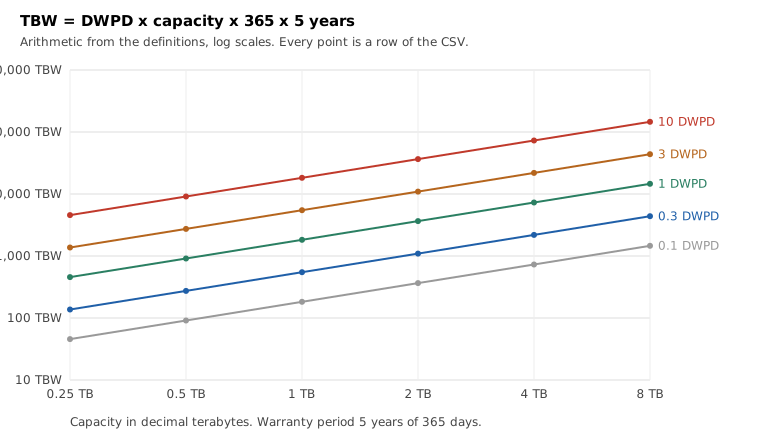
How to convert between TBW (terabytes written) and DWPD (drive writes per day) for an SSD, with a worked table of 60 rows: six capacities from 0.25 to 8 TB, warranty periods of 3 and 5 years, and DWPD ratings of 0.1, 0.3, 1, 3 and 10. The formulas are TBW = DWPD x capacity x 365 x years and DWPD = TBW / (capacity x 365 x years). Pure arithmetic from the public definitions, with no measured data and no product ratings. For example, 1 TB at 1 DWPD over 5 years is 1,825 TBW, and 600 TBW on a 1 TB drive over 5 years is 0.33 DWPD.
Download CSV60 rows · 6 columns · CSVScope and definitions
Scope: a conversion table, not a survey. It lists no product and no vendor rating. DWPD is the number of times the full capacity of the drive can be written per day over the warranty period, and TBW is the total number of terabytes that can be written over that period. These are the definitions given in the Wikipedia article on solid-state drives, which also notes that manufacturers give endurance as either n DWPD or m TBW.
Formulas
TBW = DWPD × capacity (TB) × 365 × warranty yearsDWPD = TBW ÷ (capacity (TB) × 365 × warranty years)host writes per day (GB) = DWPD × capacity (TB) × 1000full-drive P/E cycles at write amplification 1 = TBW ÷ capacity (TB), the same asDWPD × 365 × warranty years
Terabytes are decimal (1 TB = 1012 bytes) and a year is 365 days. The table is a grid of 6 capacities (0.25, 0.5, 1, 2, 4, 8 TB), 2 warranty periods (3 and 5 years) and 5 DWPD values (0.1, 0.3, 1, 3, 10): 60 rows. The build recomputes every cell from its formula and fails on a mismatch, and it checks that converting each TBW back to DWPD returns the DWPD of the row.
Worked examples
- A 1 TB drive rated 1 DWPD for 5 years: 1 × 1 × 365 × 5 = 1,825 TBW, or 1,000 GB of host writes per day. The same rating on a 4 TB drive is 7,300 TBW, and over 3 years on the 1 TB drive it is 1,095 TBW.
- The other direction: a 1 TB drive rated 600 TBW over 5 years is 600 ÷ (1 × 365 × 5) = 0.33 DWPD. The 600 TBW figure is an arithmetic example, not a product. With write amplification 1 it is 600 full-drive P/E cycles, the example the Wikipedia article gives for 1 TB and 600 TBW.
- The same TBW means a lower DWPD on a larger drive or over a longer warranty: DWPD is TBW spread over capacity and days.
Chart
Limits
- These are ratings arithmetic, not measured endurance. A real drive can wear out earlier or later than its rating, and the table says nothing about any product.
- Vendors tie a rating to a workload and a warranty period. The same drive can carry a different TBW under a different workload, so two ratings are comparable only when workload and period match.
- The P/E column assumes write amplification 1. Real write amplification is above 1, so the P/E cycles the flash actually sees are higher than that column, and the column is a count of host full-drive writes.
- Capacity is decimal and the year has 365 days. A vendor that uses another convention, or counts a leap year, will get slightly different numbers.
Table
| Capacity (TB) | Warranty (years) | DWPD | TBW | Host writes (GB/day) | P/E cycles at WAF 1 |
|---|---|---|---|---|---|
| 0.25 | 3 | 0.1 | 27.375 | 25 | 109.5 |
| 0.5 | 3 | 0.1 | 54.75 | 50 | 109.5 |
| 1 | 3 | 0.1 | 109.5 | 100 | 109.5 |
| 2 | 3 | 0.1 | 219 | 200 | 109.5 |
| 4 | 3 | 0.1 | 438 | 400 | 109.5 |
| 8 | 3 | 0.1 | 876 | 800 | 109.5 |
| 0.25 | 3 | 0.3 | 82.125 | 75 | 328.5 |
| 0.5 | 3 | 0.3 | 164.25 | 150 | 328.5 |
| 1 | 3 | 0.3 | 328.5 | 300 | 328.5 |
| 2 | 3 | 0.3 | 657 | 600 | 328.5 |
| 4 | 3 | 0.3 | 1,314 | 1,200 | 328.5 |
| 8 | 3 | 0.3 | 2,628 | 2,400 | 328.5 |
| 0.25 | 3 | 1 | 273.75 | 250 | 1,095 |
| 0.5 | 3 | 1 | 547.5 | 500 | 1,095 |
| 1 | 3 | 1 | 1,095 | 1,000 | 1,095 |
| 2 | 3 | 1 | 2,190 | 2,000 | 1,095 |
| 4 | 3 | 1 | 4,380 | 4,000 | 1,095 |
| 8 | 3 | 1 | 8,760 | 8,000 | 1,095 |
| 0.25 | 3 | 3 | 821.25 | 750 | 3,285 |
| 0.5 | 3 | 3 | 1,642.5 | 1,500 | 3,285 |
| 1 | 3 | 3 | 3,285 | 3,000 | 3,285 |
| 2 | 3 | 3 | 6,570 | 6,000 | 3,285 |
| 4 | 3 | 3 | 13,140 | 12,000 | 3,285 |
| 8 | 3 | 3 | 26,280 | 24,000 | 3,285 |
| 0.25 | 3 | 10 | 2,737.5 | 2,500 | 10,950 |
| 0.5 | 3 | 10 | 5,475 | 5,000 | 10,950 |
| 1 | 3 | 10 | 10,950 | 10,000 | 10,950 |
| 2 | 3 | 10 | 21,900 | 20,000 | 10,950 |
| 4 | 3 | 10 | 43,800 | 40,000 | 10,950 |
| 8 | 3 | 10 | 87,600 | 80,000 | 10,950 |
| 0.25 | 5 | 0.1 | 45.625 | 25 | 182.5 |
| 0.5 | 5 | 0.1 | 91.25 | 50 | 182.5 |
| 1 | 5 | 0.1 | 182.5 | 100 | 182.5 |
| 2 | 5 | 0.1 | 365 | 200 | 182.5 |
| 4 | 5 | 0.1 | 730 | 400 | 182.5 |
| 8 | 5 | 0.1 | 1,460 | 800 | 182.5 |
| 0.25 | 5 | 0.3 | 136.875 | 75 | 547.5 |
| 0.5 | 5 | 0.3 | 273.75 | 150 | 547.5 |
| 1 | 5 | 0.3 | 547.5 | 300 | 547.5 |
| 2 | 5 | 0.3 | 1,095 | 600 | 547.5 |
| 4 | 5 | 0.3 | 2,190 | 1,200 | 547.5 |
| 8 | 5 | 0.3 | 4,380 | 2,400 | 547.5 |
| 0.25 | 5 | 1 | 456.25 | 250 | 1,825 |
| 0.5 | 5 | 1 | 912.5 | 500 | 1,825 |
| 1 | 5 | 1 | 1,825 | 1,000 | 1,825 |
| 2 | 5 | 1 | 3,650 | 2,000 | 1,825 |
| 4 | 5 | 1 | 7,300 | 4,000 | 1,825 |
| 8 | 5 | 1 | 14,600 | 8,000 | 1,825 |
| 0.25 | 5 | 3 | 1,368.75 | 750 | 5,475 |
| 0.5 | 5 | 3 | 2,737.5 | 1,500 | 5,475 |
| 1 | 5 | 3 | 5,475 | 3,000 | 5,475 |
| 2 | 5 | 3 | 10,950 | 6,000 | 5,475 |
| 4 | 5 | 3 | 21,900 | 12,000 | 5,475 |
| 8 | 5 | 3 | 43,800 | 24,000 | 5,475 |
| 0.25 | 5 | 10 | 4,562.5 | 2,500 | 18,250 |
| 0.5 | 5 | 10 | 9,125 | 5,000 | 18,250 |
| 1 | 5 | 10 | 18,250 | 10,000 | 18,250 |
| 2 | 5 | 10 | 36,500 | 20,000 | 18,250 |
| 4 | 5 | 10 | 73,000 | 40,000 | 18,250 |
| 8 | 5 | 10 | 146,000 | 80,000 | 18,250 |
Columns
- capacity_tb
- Drive capacity in decimal terabytes (1 TB = 10^12 bytes).
- warranty_years
- Warranty period in years, each of 365 days.
- dwpd
- Drive writes per day: full-capacity writes per day allowed for the warranty period.
- tbw
- Terabytes written over the warranty period: dwpd * capacity_tb * 365 * warranty_years. Exact decimal arithmetic.
- host_writes_gb_per_day
- dwpd * capacity_tb * 1000, gigabytes of host writes per day.
- pe_cycles_at_waf_1
- tbw / capacity_tb = dwpd * 365 * warranty_years: full-drive program/erase cycles used if write amplification is 1. Real drives have write amplification above 1, so this is a count of host full-drive writes.
License
The table is arithmetic computed here from the public definitions of TBW and DWPD. No third-party data or specification text is copied and no product rating is listed. Reuse is fine with attribution to this site.
Wikipedia reuse terms · Definitions source